

WORLD CUP TORONTO
These two articles first appeared in German in the Soester Anzeiger

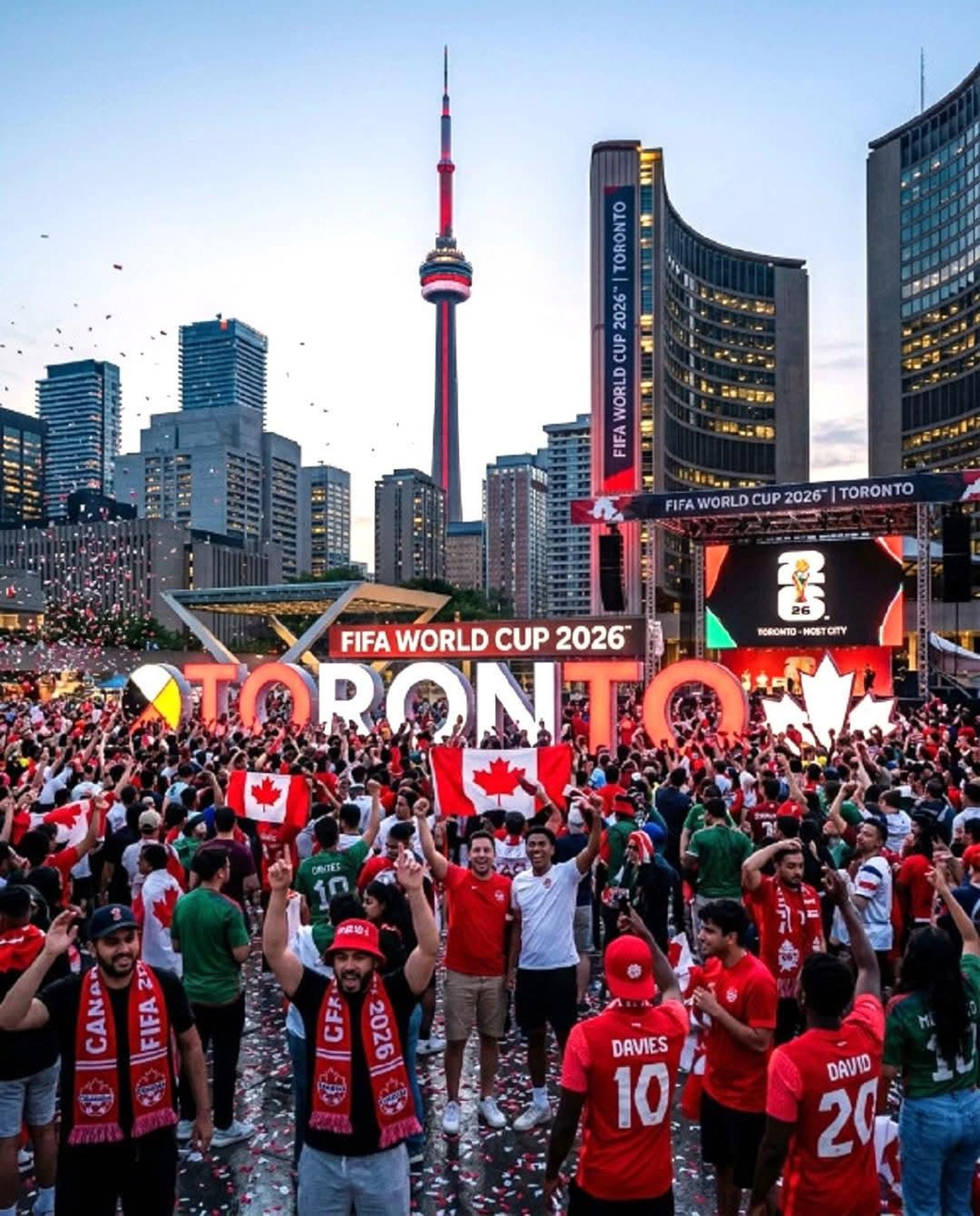
Nathan Phillips Square, Toronto
A funny thing happened as I was trying to decide whether to boycott FIFA’s World Cup over all kinds of shit or just lay back and watch host Canada enjoy its moment in the sun. I tried this for the last world cup in Qatar, just turn the TV off, because who wants to watch a sporting spectacle where the host employs slave labour to build it and stage it? Brave idea, but as soon as the games started, I watched, I’m a certified soccer nut and a fickle boycotter.
The funny thing: The Soester Anzeiger, my German hometown newspaper asked me to write an article about my impressions of the world cup vibe in Toronto for Canada’s first game. Didn’t see that coming. Also didn’t blink, and took the gig.
Human rights indifference is not the only thing FIFA is known for, there’s media marketing kickbacks in exchange for broadcasting rights, and then we have hosting rights bribery and a buttload of other self-enrichment schemes that made FIFA leadership millions in bonuses and unearned payments.
My instincts told me that the World Cup hungry readership of Soest wouldn’t be interested in any of the above. So, I kept my reporting to, what’s it like to be there. After I submitted the first item, the Anzeiger editor asked for another one, Germany was to play Ivory Coast in Toronto, could I cover it? Who wouldn’t?
Allow me to foist on Facts are Subversive subscribers then, more content that is not as advertised, i.e. two articles that are not about journalism but they are about the human condition.
The following two articles first appeared in German in the Soester Anzeiger
WORLD CUP DAY
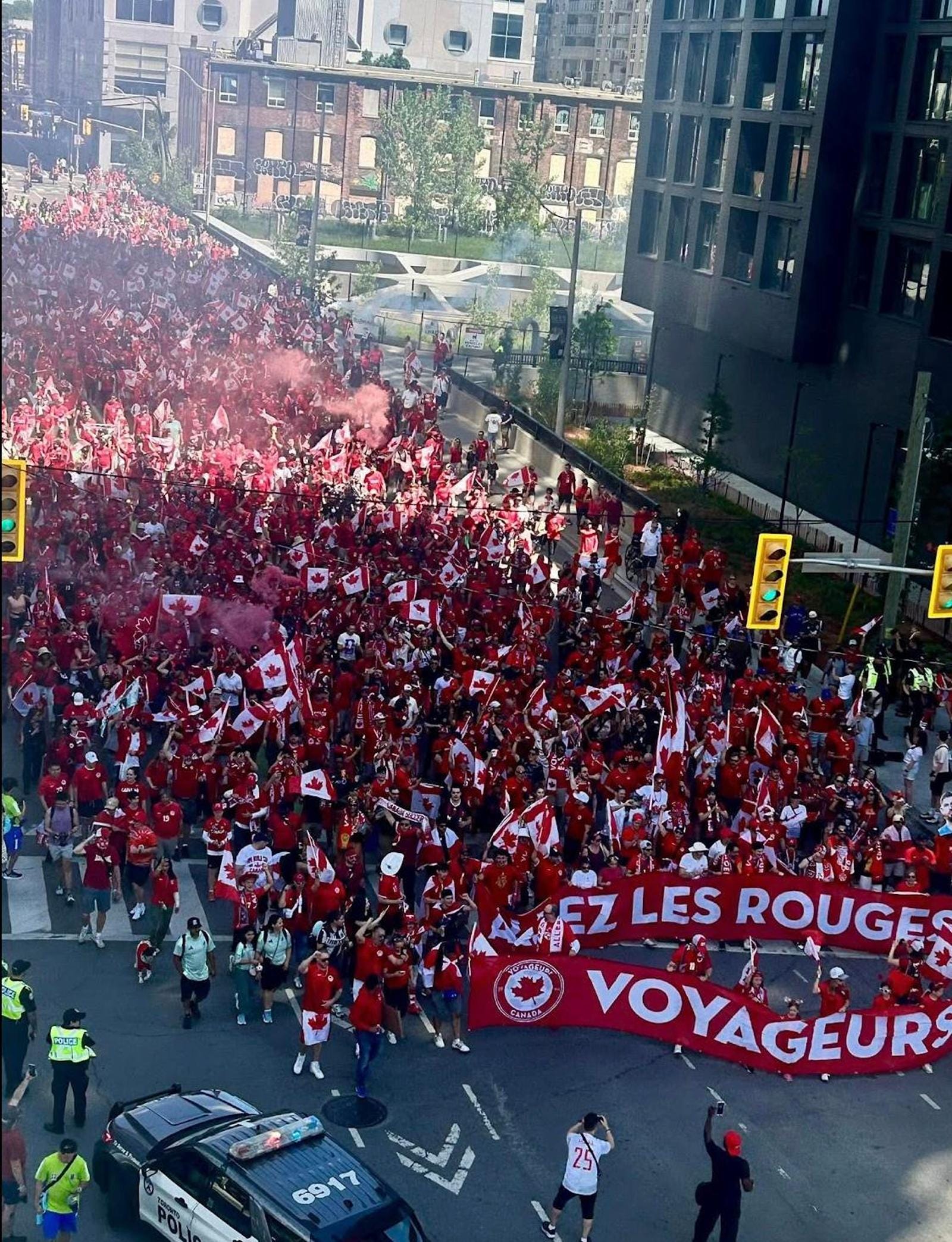
VOYAGEURS
When CBC, Canada’s federal broadcaster, hosts the national news from Toronto’s World Cup stadium, you know soccer has finally arrived in the land of the maple leaf. In fact, thousands of maple leaves exploded in a sea of red and white madness at fan fest venues across the country when Cyle Larin blasted the tying goal past Bosnian keeper Nikola Vasilj in the opening group match of World Cup ‘26.
In Canada the kind of red delirium that followed Larin’s goal is typically reserved for game seven hockey madness on ice. But on this bright sunny afternoon in June a journeyman footballer currently plying his trade with EFL Championship club Southampton and born just a free kick north of the stadium by Lake Ontario, has burnished the maple leaf into the soccer-media-industrial complex for good. Canada’s first men’s FIFA result, ever. A one-one draw.
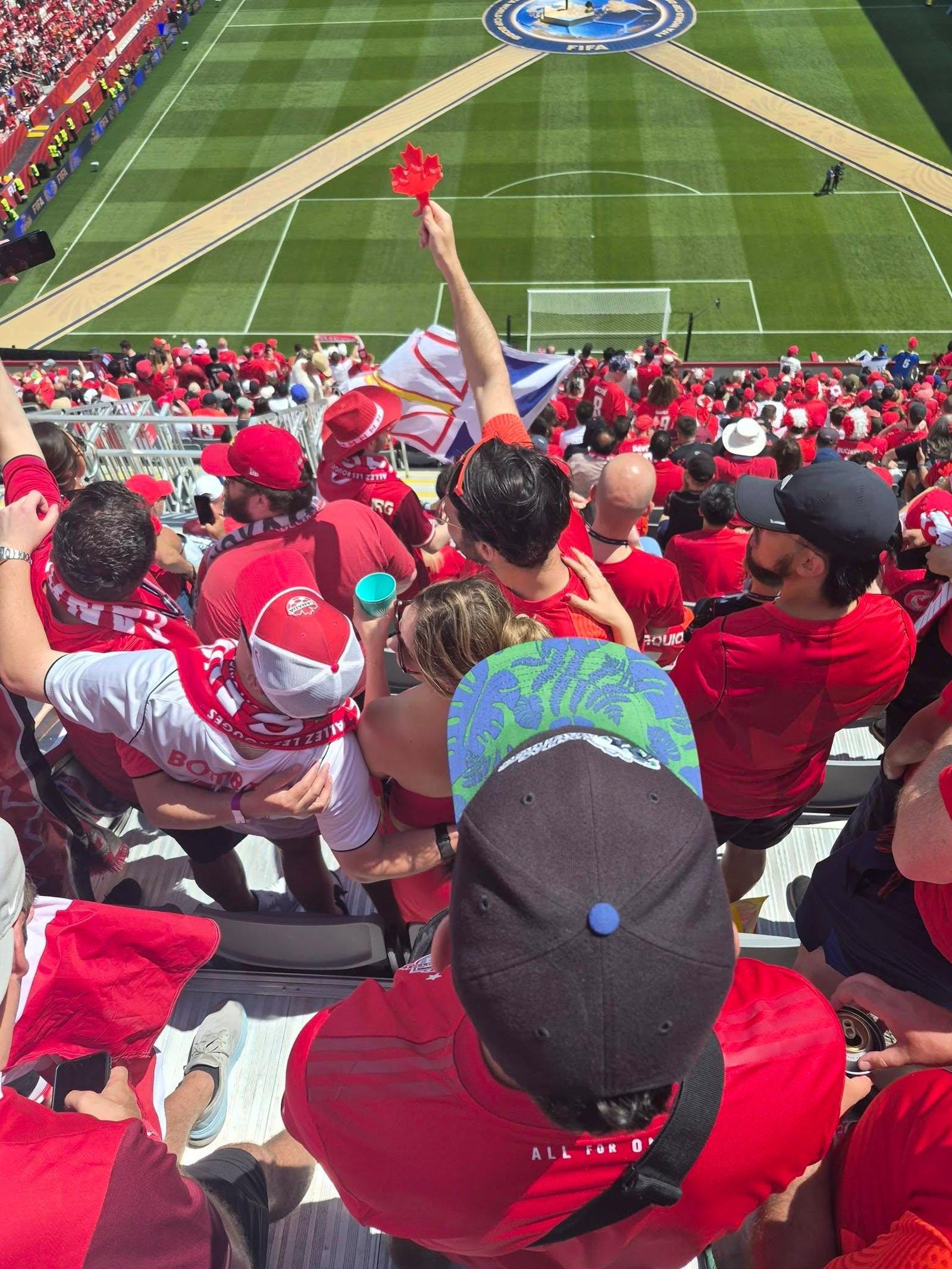
“It was all surreal. I never imagined a world cup game here and yet here we are.” David Campbell traveled from the Ottawa area with his son and grandson for the tournament opener. “After seeing such sluggish support over the years, it was gratifying to see the nation finally embracing the team.”
Canadian-born Campbell got his love of soccer from his English mother, but he never played nor passed the sport on to his sons. Son Sean, a lifelong hockey fan came to soccer through the side door, MLS supporter culture.
“I didnt know what supporters were when I first started watching,” says Campbell. “When I went to my first Toronto FC game, it was against LA Galaxy in the CONCACAF Champions League. I walked in and saw this banner and an entire end of supporters, and I thought to myself, thats where I want to be.”
Sean and his father have been members of the Voyageurs ever since, the official national soccer supporters group that occupies the thunderous and rouge-infused home end zone at TFC and international matches.
“We went from empty stadiums and losses in 2012 to having an entire nation back us,” says Campbell. The growth of supporter culture has grown easily 100-fold in Canada in the 14 years since our worst FIFA ranking. They say away days are the best days, but they have never hosted the world.”
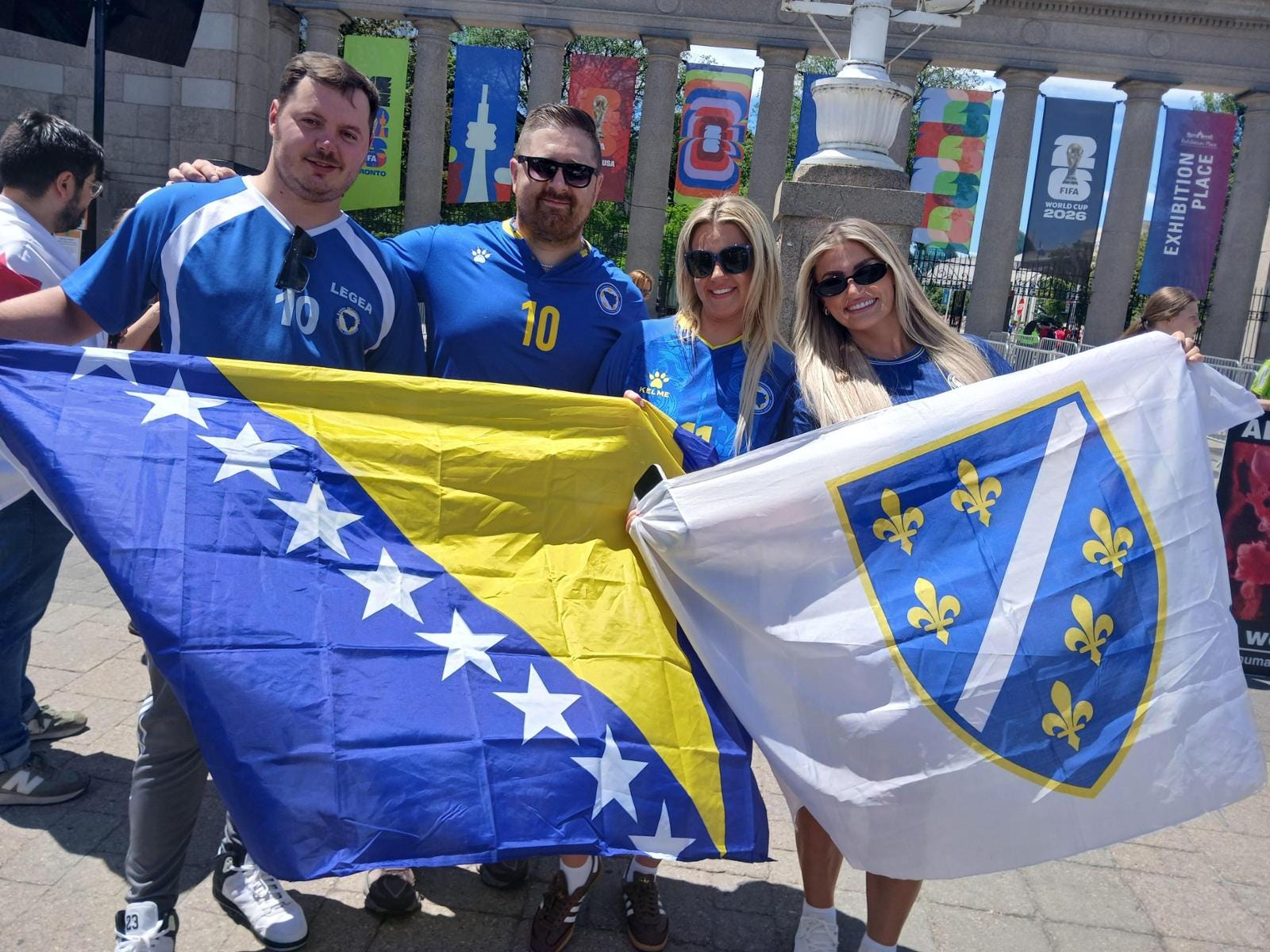
Bosnian fans
FIFA’s world cup of soccer has traditionally not meant the world to most Canadian sports fans except to those who are not from here. Toronto, the nation’s ‘multicultural melting pot’ is turning out in numbers and with pride at Fanzone events prior to the historic Canada vs. Bosnia-Herzegovina showdown at the Toronto stadium.
David Campbell has high expectations for the 2026 Rouges squad. “I wasn’t surprised by our performance and we should have won the game. But like most games they start sloppy and dug a hole to climb out of.”
Campbell says he was glad to be a part of the supporter group. “As a single ticket holder I never felt alone and it was like hanging with family. Hoping to be able to travel to Europe for 2030.”
Membership in the Voyageur supporter group got the Campbells in the line-up for more affordable tickets.
Son Sean, a youth soccer coach himself, says the team’s strong showing was the result of Canada’s focus on player development.
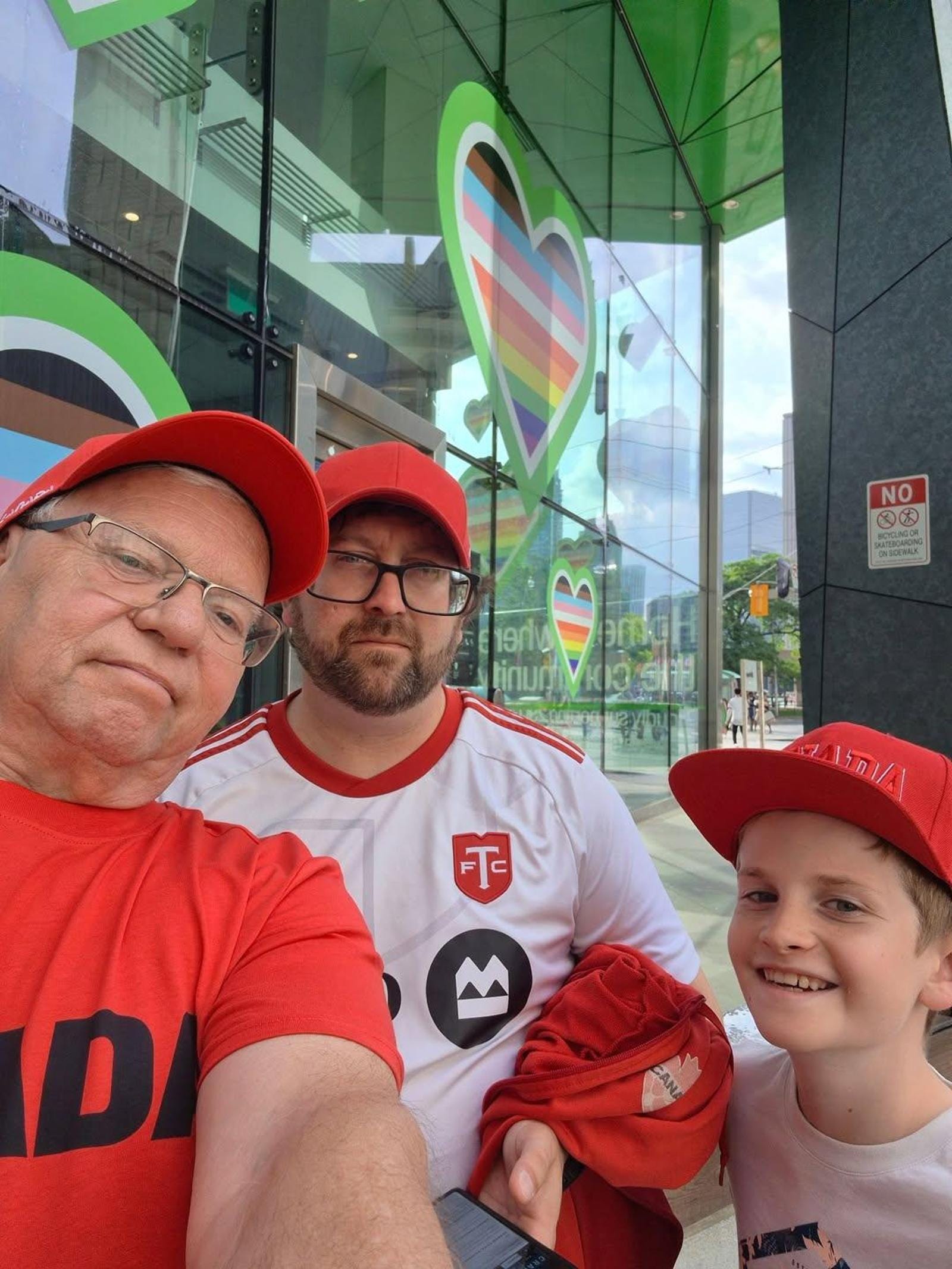
The Campbells
“Our roster is the result of a shift in the way we do soccer, from grassroots all the way to professional development leagues and the Canadian Premiere League,” says Campbell. “Its creating a proper pathway for players from the ground up. Its what is going to make us a real contender in the years to come.”
Will Canada’s first result on the world soccer stage launch the land of immigrants into a land where soccer will always be football and where football is culture?
We’ll wait.
-30-
MATCH DAY
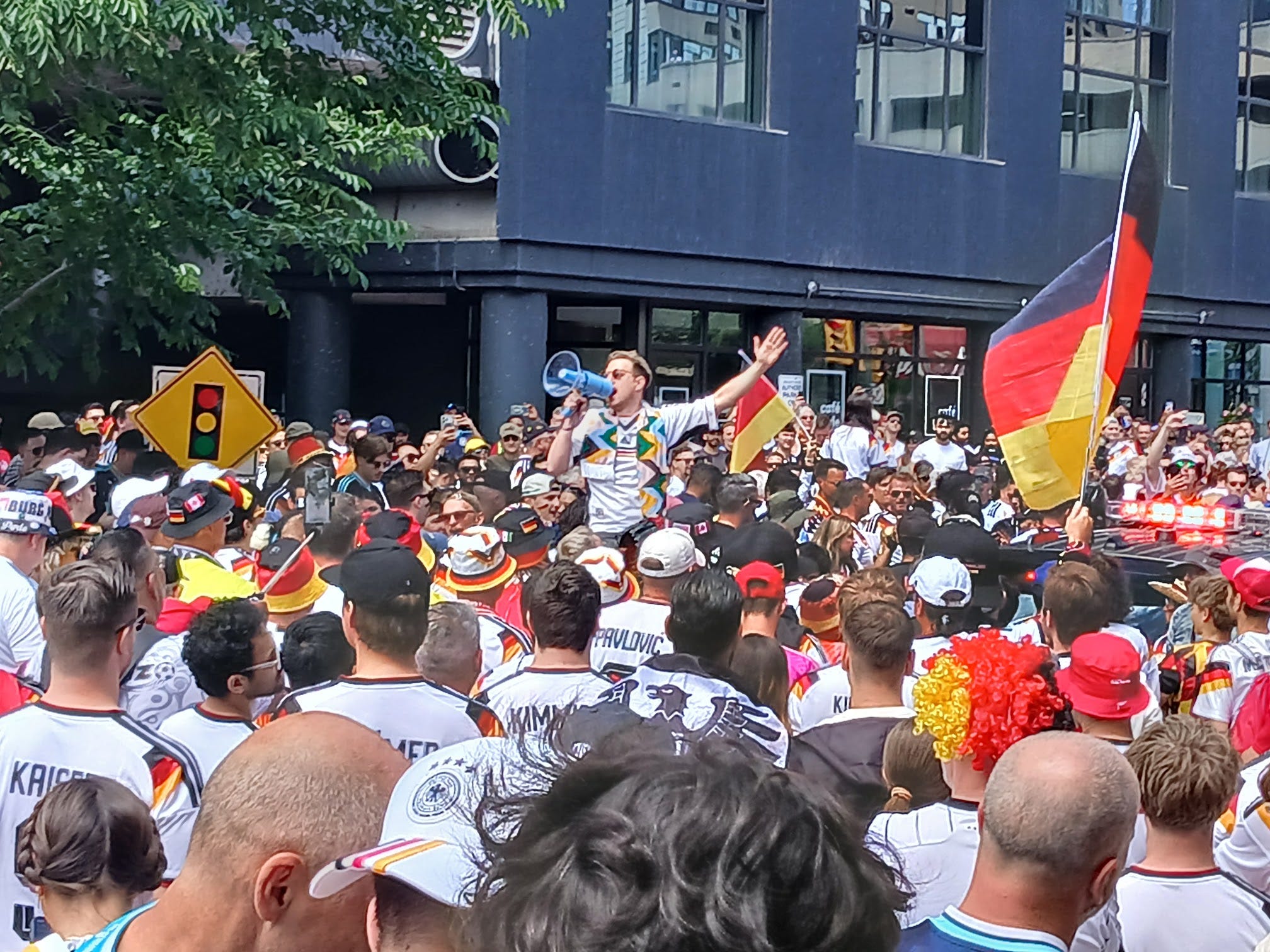
The Amsterdam Brewhouse is a popular waterfront brewpub in downtown Toronto that also serves as a prominent gathering spot for German soccer fans when ‘Die Mannschaft’ is in town to play at Toronto Stadium. Today at high noon on matchday two against group E opponent Ivory Coast, the vicinity surrounding the Brewhouse and way beyond is a sea of black, red, and gold. The pregame pep-rally is in full roar.
“Germany forever, we never give up
When the team plays, the world spins loud”
The cheer captain, megaphone to his face is rallying his irrepressible troops, thousands of them, decked out in varied, garish and multicoloured German national team glory. Spearheaded by a boisterous band of banner-wielding Ultras, the organized chanting and hollering and driving drum beats are heading west along the lakeshore to Exhibition Place, the national exhibition grounds where BMO Field , home of MLS club Toronto FC, which has been temporarily renamed Toronto Stadium for the 2026 FIFA World Cup, was first built in 2007.
The marchers, directed by the megaphone, sing an entire repertoire of well-known German football anthems.
“Oh, oh, hey, oh, hey
Time for a change!”
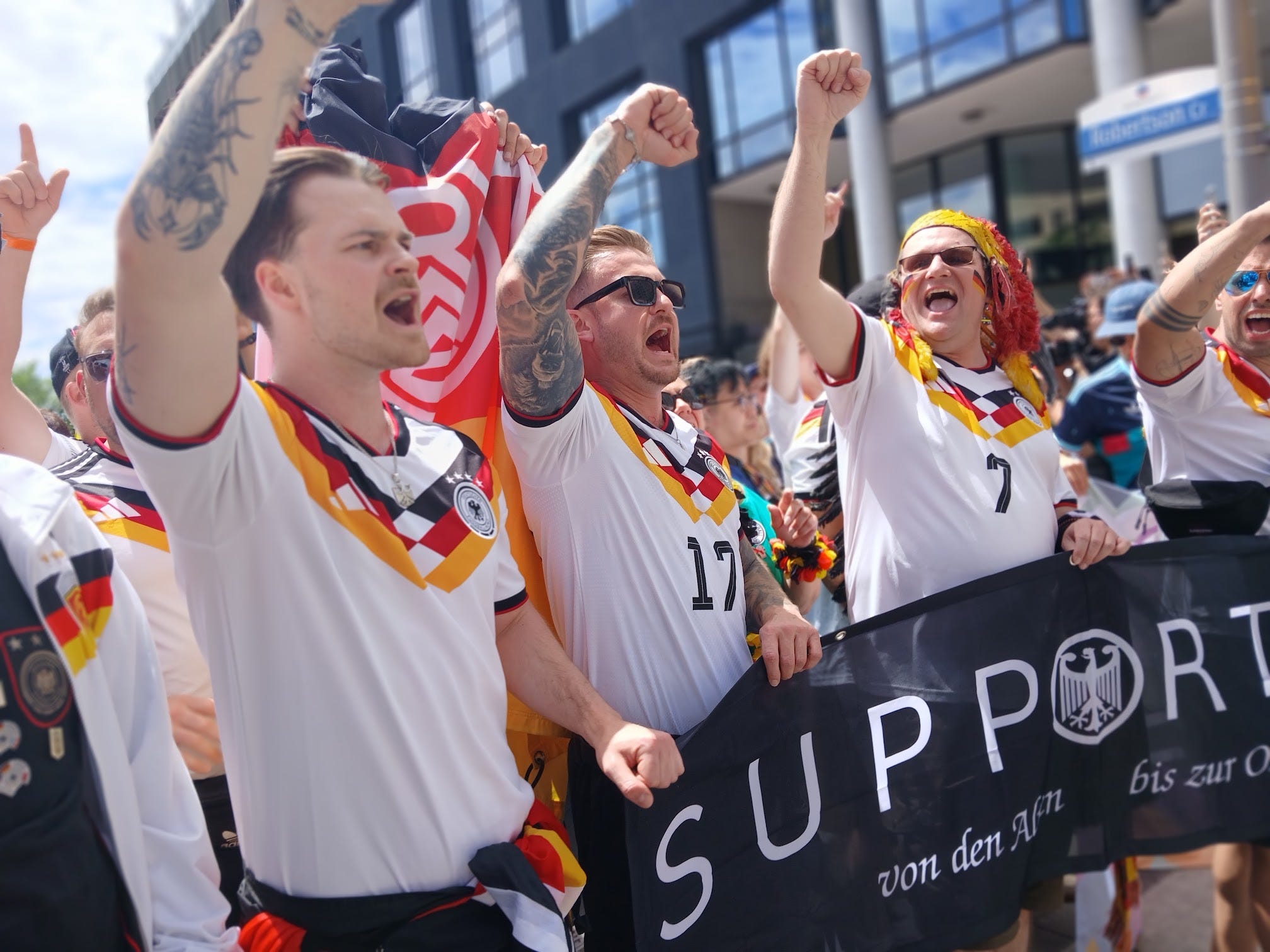
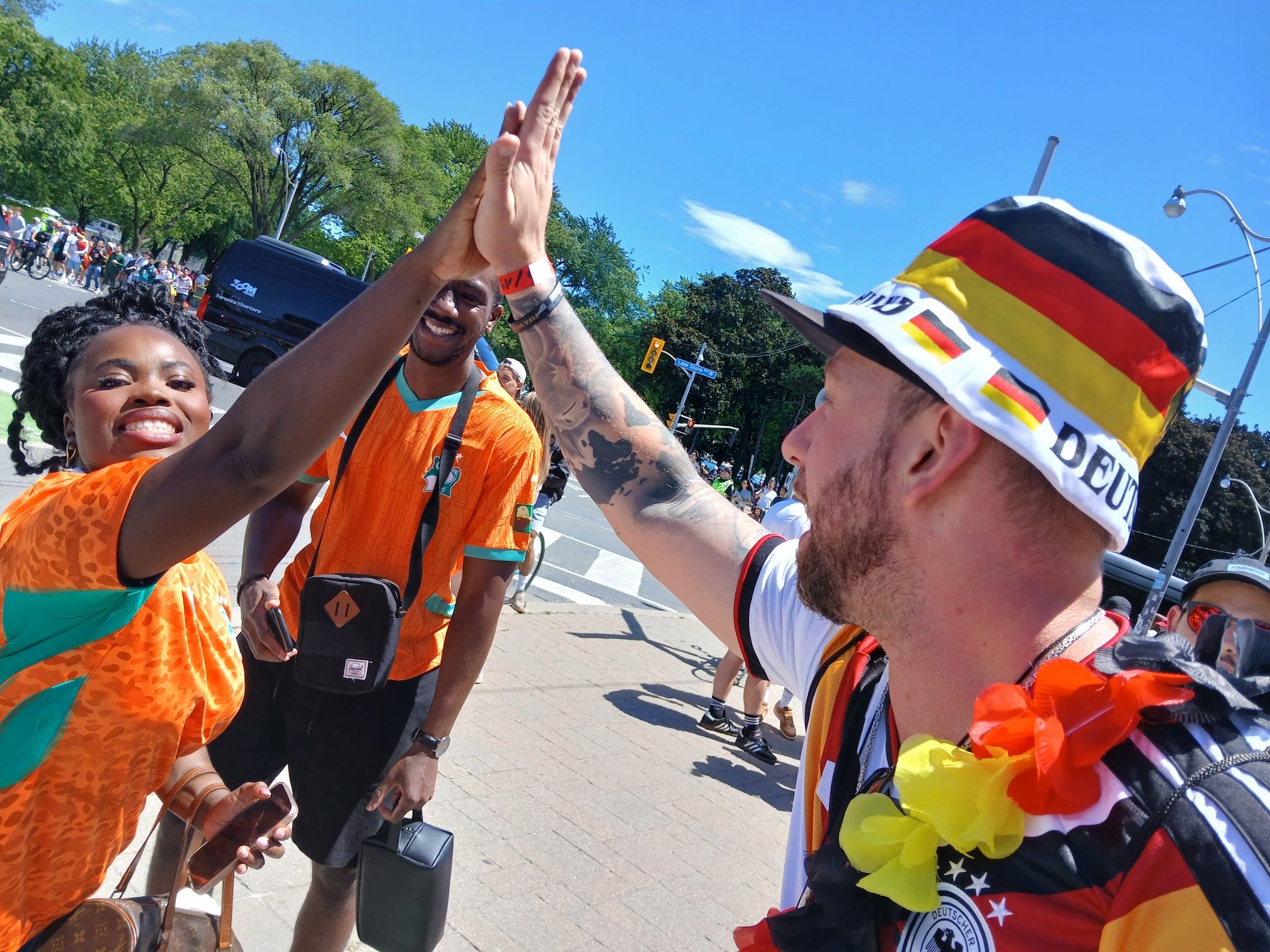
On this splendid summer day Toronto is hosting more than a football match. It feels and sounds like Canada’s largest city and the capital of its largest province, Ontario, is hosting an out and out international German sport festival that apparently includes a curious sporting tradition that locals would recognize as cultural appropriation. As a boy growing up on Karl May and James Fenimore Cooper, Germans’ historical fascination with all things “Indian” is not unknown to me, but as a downtown Toronto citizen exposed daily to Indigenous appropriation issues, seeing faux First Nations headgear in a mass sports parade with barely a whisper on social media and nothing in the news is truly a headscratcher.
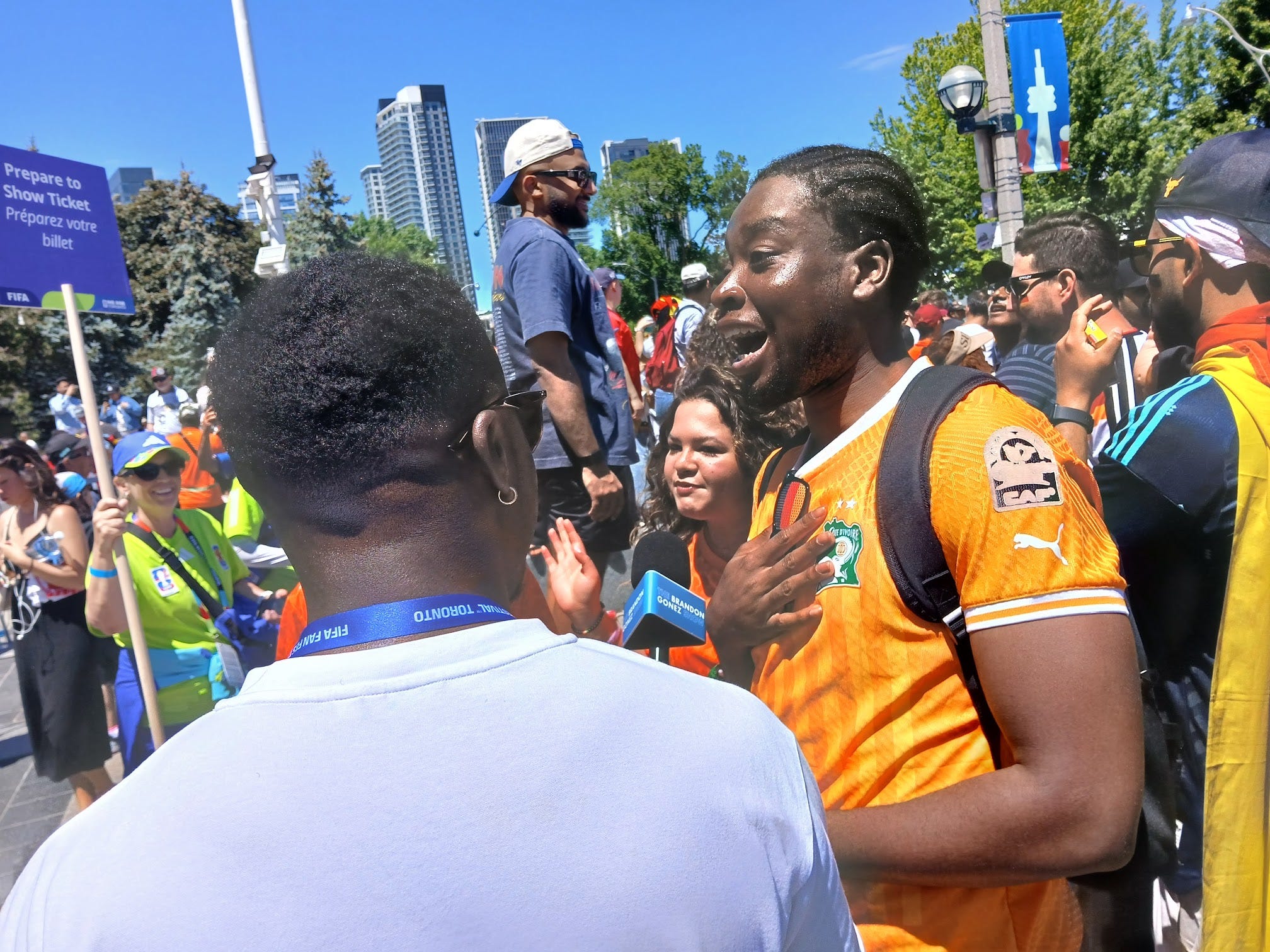
Brandon Gonez working the crowd
Brandon Gonez, a local TV talk show host is brandishing a microphone as he wades into the horde of marchers with his camera-wielding producer looking to capture fan reactions. He’s amazed at the diversity of people in the massive game day parade.
“It is so electric, to see the Côte D’Ivoire fans and the German fans all come together, hearing the chants, seeing the camaraderie of both sets of fans.” Gonez is beaming. “It’s the perfect place for world cup matches. Sport brings people together. With so much division in the world to see people come together with love and unity. I wish I could see that every day.”
German-Canadian software professional Stephan Anders, 48, is a long-time Toronto resident whose globe-trotting friend and fellow fervent Hamburger SV fan Max Hildebrandt is visiting from Hamburg to take in the festival, and the match. Anders says he was overwhelmed by the tremendous number of German supporters at the fan march.
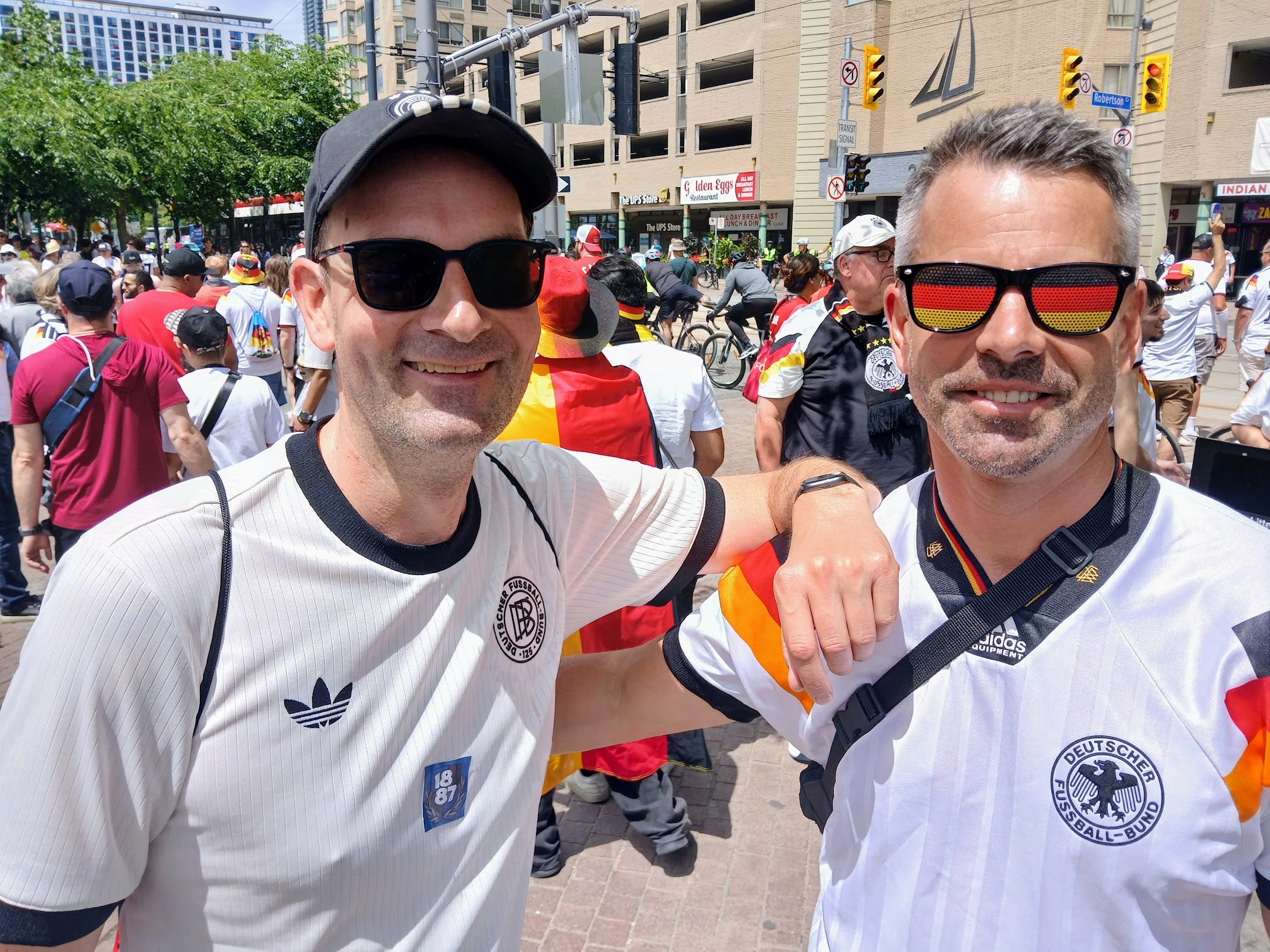
Stephan Anders & Max Hildebrandt
“It was my first time ever, to see the German national team live. And then, in Toronto, my home, and then, at the world cup! A once-in-a-lifetime experience.”
As first-timer Anders and friend Hildebrandt are swallowed up by the throbbing throng of football frolickers, ten-time world cup experiencer Günther Stiebig from Alsfeld in Hessen is holding forth in front of the exhibition gates wearing a T-shirt listing every World Cup that he’s attended. Stiebig has seen it all but says it’s difficult to compare world cups when so much of our world has changed in the 36 years since his first at Rome in 1990. Asked about his Toronto experience Stiebig says that although football, especially the world cup, is the main reason for his far-off travels, “the game is only a small part of the whole thing”.
“Since I booked my hotel a little outside of downtown, I’m taking public transportation into the city center. On my way to the bus stop, I walked through well-kept residential areas in Etobicoke and had a nice chat with Tim, who was washing his car. He was very friendly and wanted to know where I was from and if I was watching the World Cup. He said he wasn’t a big football fan himself, but since the World Cup was being held there, he was watching it too. He wished me a good time and lots of fun! This encounter reflects my experience so far, because in Canada you find many friendly, helpful, and very open people! So far, I’m very happy to have traveled to Canada, specifically Toronto, and it’s somewhat comparable to the openness and friendliness I experienced in South Africa in 2010.”
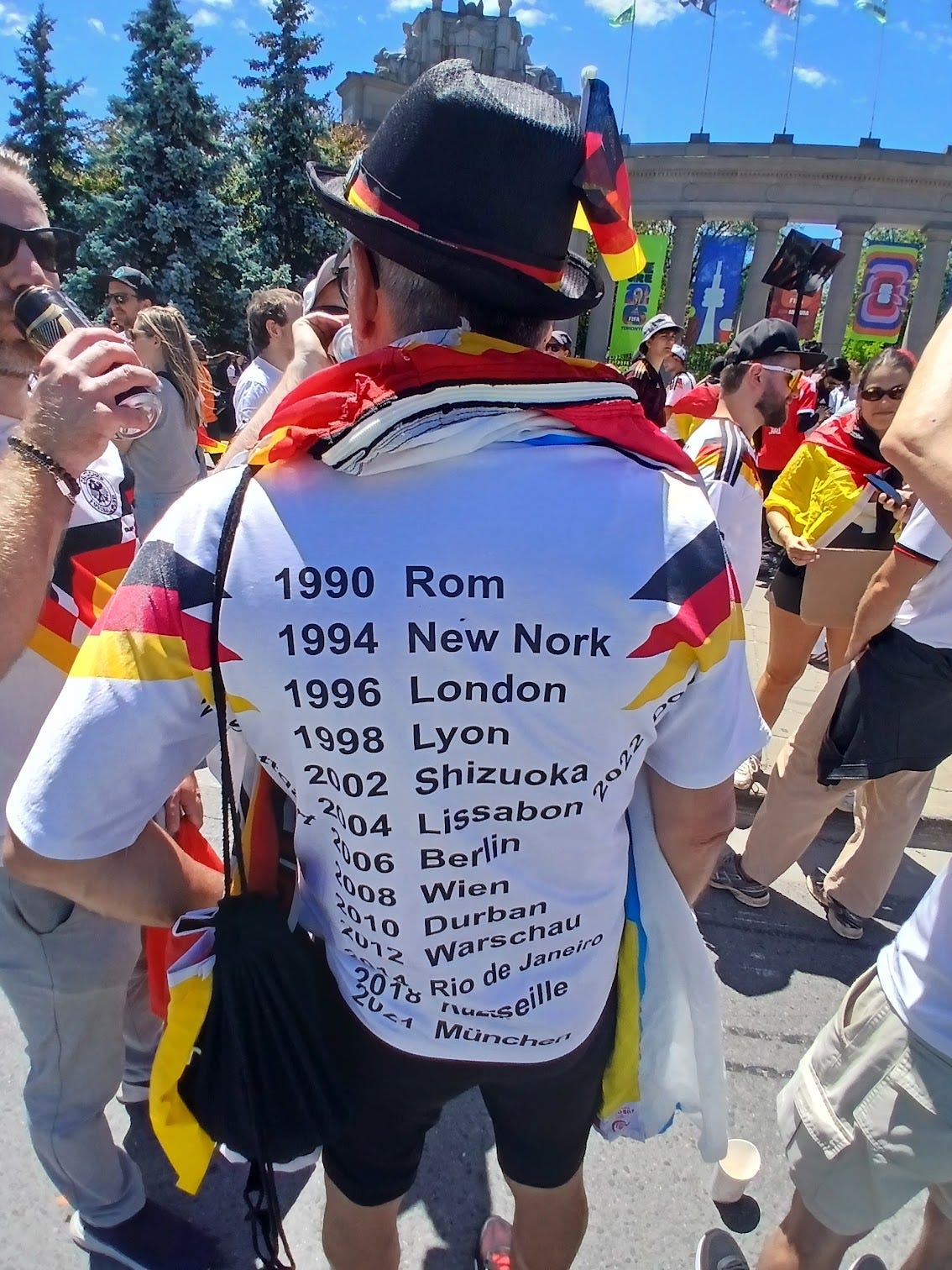
Günther Stiebig
The Ultras are gathering at the entrance for one final co-ordinated onslaught on Toronto Stadium. “This looks like Berlin” yells a recent and surprised arrival. In fact, the entrance to the grounds of the Canadian National Exhibition, built in 1927 in the Beaux-Arts style, indeed resembles the imposing architecture of the Brandenburg Gate.
Two young men sporting Germany shirts with raised cardboard signs advertising they need game tickets are nervously checking their mobile phones as hordes of colorfully dressed, exuberant fans file past and stream into the stadium alley.
A group of well-known football fans from the Weser town of Höxter are easily recognizable by their legendary jerseys from German football history as they make their way shoulder to shoulder into the stadium: Manuel Wenzel wears Franz Beckenbauer’s number five, Christoph Altmiks the legendary number nine of Rudi Völler, Markus Finger is Gerd Müller, and Steffen Mönnekes looks simply dashing in the light blue training jacket of the legendary national coach Helmut Schön and his famous flat cap.
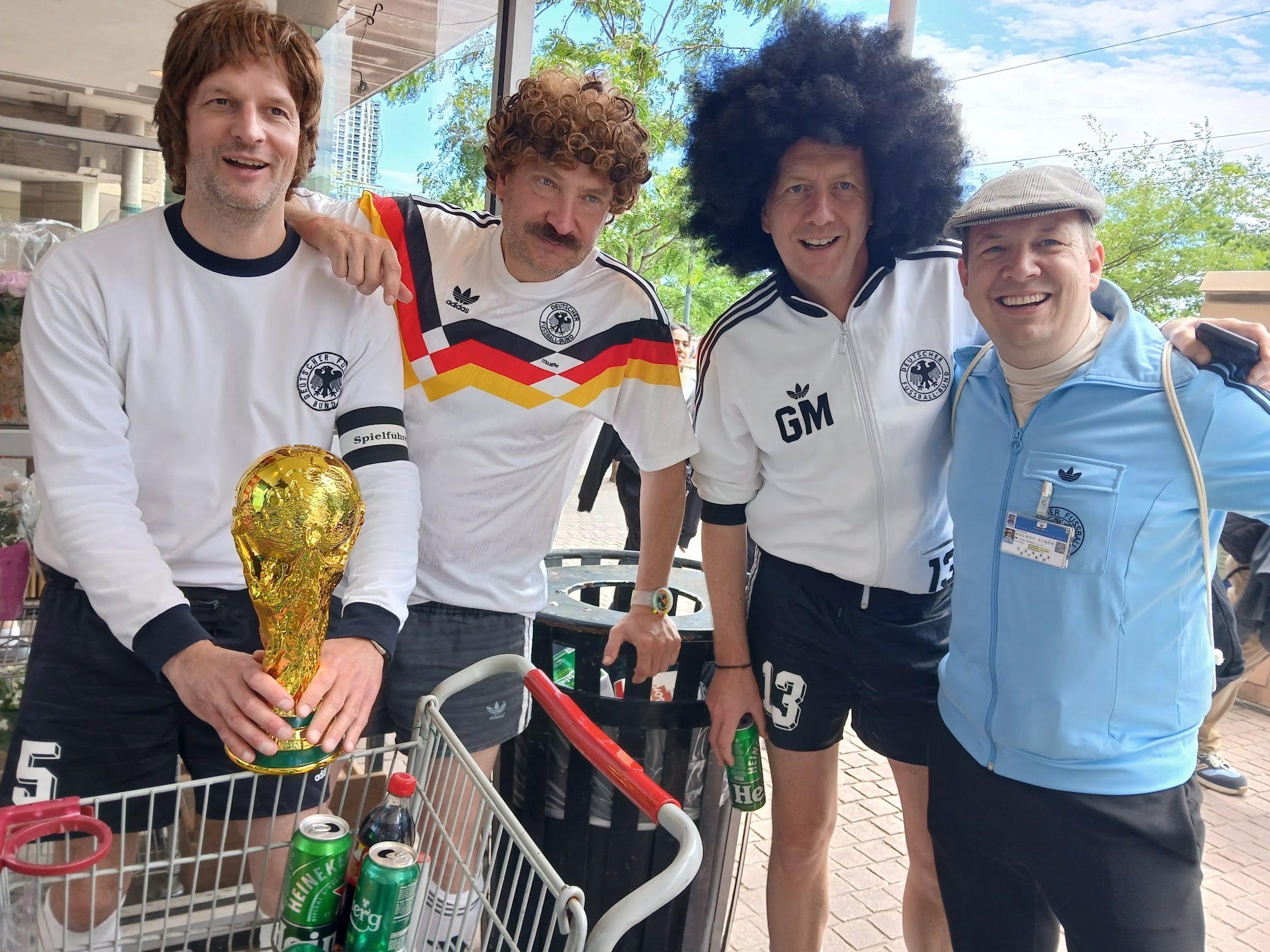
Höxter “football legends”
The Höxter “football legends,” who travel to German international matches worldwide, brought their special brand of fan culture to the World Cup in Toronto.
Markus Finger (Müller), press officer for the town of Höxter, also a DJ, raved about his experiences in Toronto before the group traveled to Buffalo and then New York City for Germany’s next match.
Finger reports: “The fan march along the waterfront to the stadium was fantastic. We were impressed by the cleanliness of the city and the large number of young people. Liberal, democratic, and young. Excellent! We wish Canada continued success at the World Cup, both on and off the field!”
Stephan Sanders, who had only ever seen his club Toronto FC play in the MLS, raved about the quality of international football after the match, and his friend Max Hildebrandt was beside himself. “The stadium was in a state of euphoria, the ultras in the North Stand, the last-minute goal – I hadn’t expected that, it was utter chaos, but peaceful, nothing got out of hand. After the game, we fans met up and celebrated. It’s a completely different dynamic when you meet people from all over the world. There were Mexicans, Ivorians, and Canadians. We danced and drank. It was a truly international experience and showed us once again what the World Cup is all about: bringing people together.”
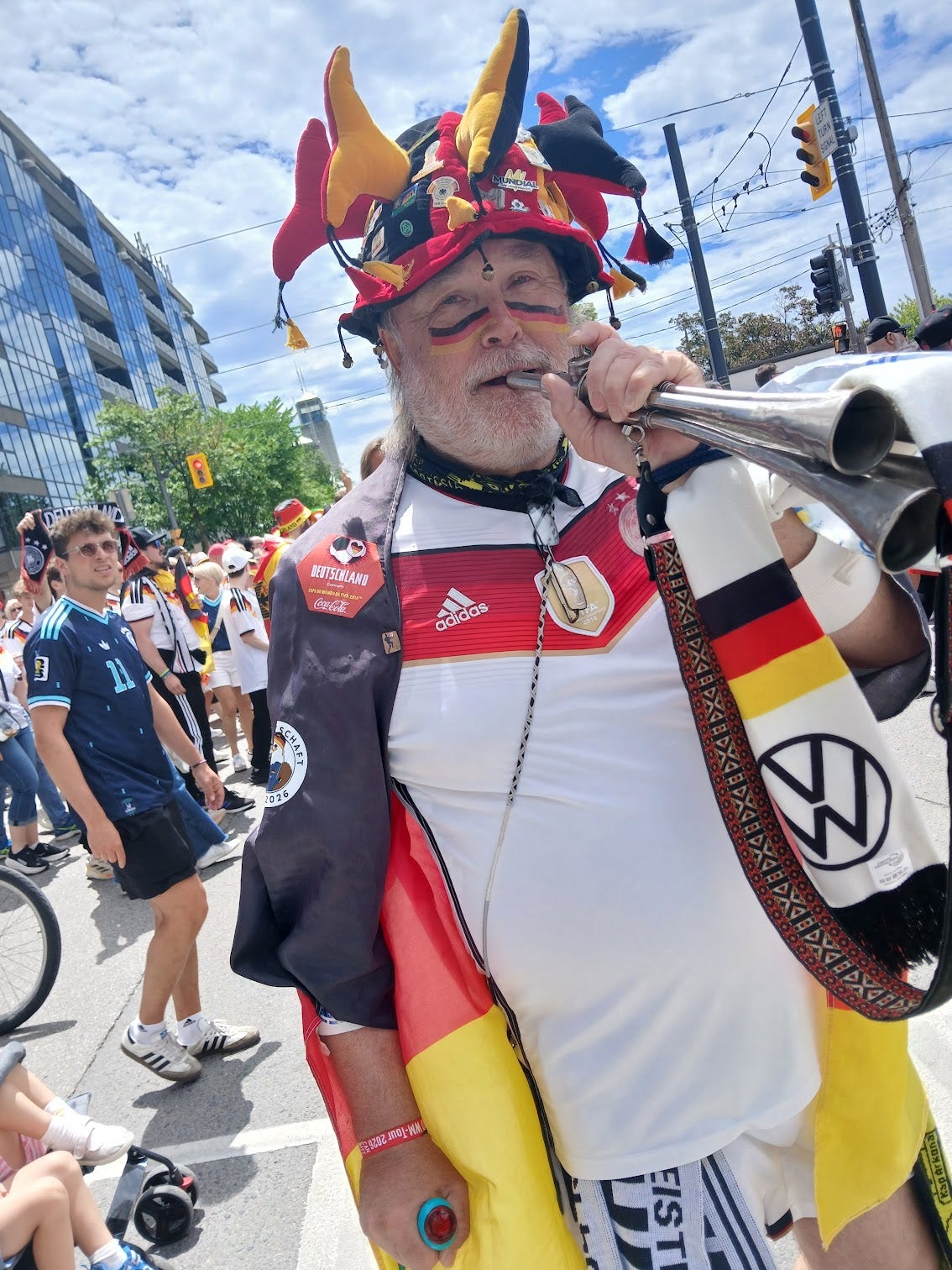
“Oh, how beautiful it is!
Oh, how beautiful it is!
We haven’t seen anything like this in a long time,
so beautiful, so beautiful!“
For Günther Stiebig, the long-time head of the DFB training centre in Alsfeld and a World Cup veteran, things aren’t what they used to be.
“On match day, you immerse yourself in the world of football fans, enjoying the shared anticipation, celebrating with other fans, and hoping for a successful game. Unfortunately, commercialism has completely taken over, and so much is regulated, so I can no longer truly enjoy it with the same enthusiasm. I often think back to the simpler but more enjoyable World Cups of the 90s and early 2000s, when the focus was more on the game itself, not the commercialism.”
There is plenty of evidence for this in Toronto’s business community where local bars and pubs, for example, circumvent FIFA’s strict trademark regulations by avoiding protected terms like “World Cup” and “FIFA” in all their advertising and on all their signage. Instead of official trademarks, they rely on generic football terms, national flags, and coded matchday motifs to signal to their customers that they are showing the games.
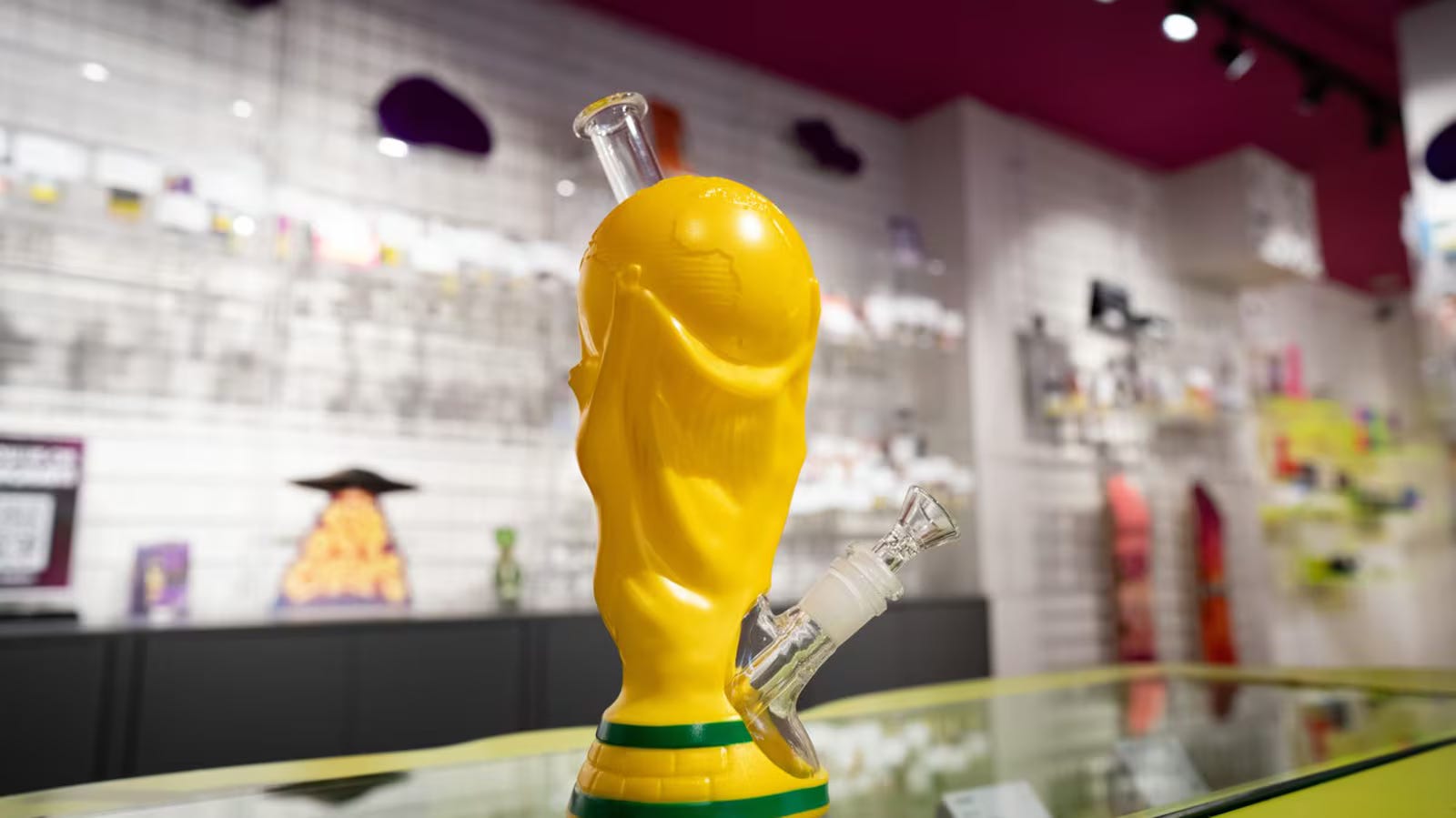
World Cup Bong
An amusing but typically Canadian anecdote: FIFA sent a cease and desist letter to Cosmic Charlies, a Queen Street cannabis dispensary, for selling an unauthorized fifty dollar “FIFA bong” that resembled the World Cup trophy. According to Reuters, the shop owners complied with FIFA’s copyright infringement request and destroyed the unauthorized bongs, but benefited from the unexpected publicity the sensational dispute that went viral, generated.
Stiebig says he doesn’t want to be too critical about the World Cup and is looking forward to his last few days in Canada and to more “great encounters and experiences” before heading to the next game in New York City. When asked why he repeatedly subjects himself to the logistical nightmares of international travel, Stiebig recently told the local press in Hessen before departing for Toronto:
“A World Cup is more than just soccer. It’s about getting to know other cultures and other people. You come into contact with people you would otherwise never meet. The sporting aspect is just the icing on the cake.”
The headlines in the local press read: “Germany Takes Over Toronto.” The residents of Toronto will long remember the unbridled energy unleashed by a throng of German football fanatics.
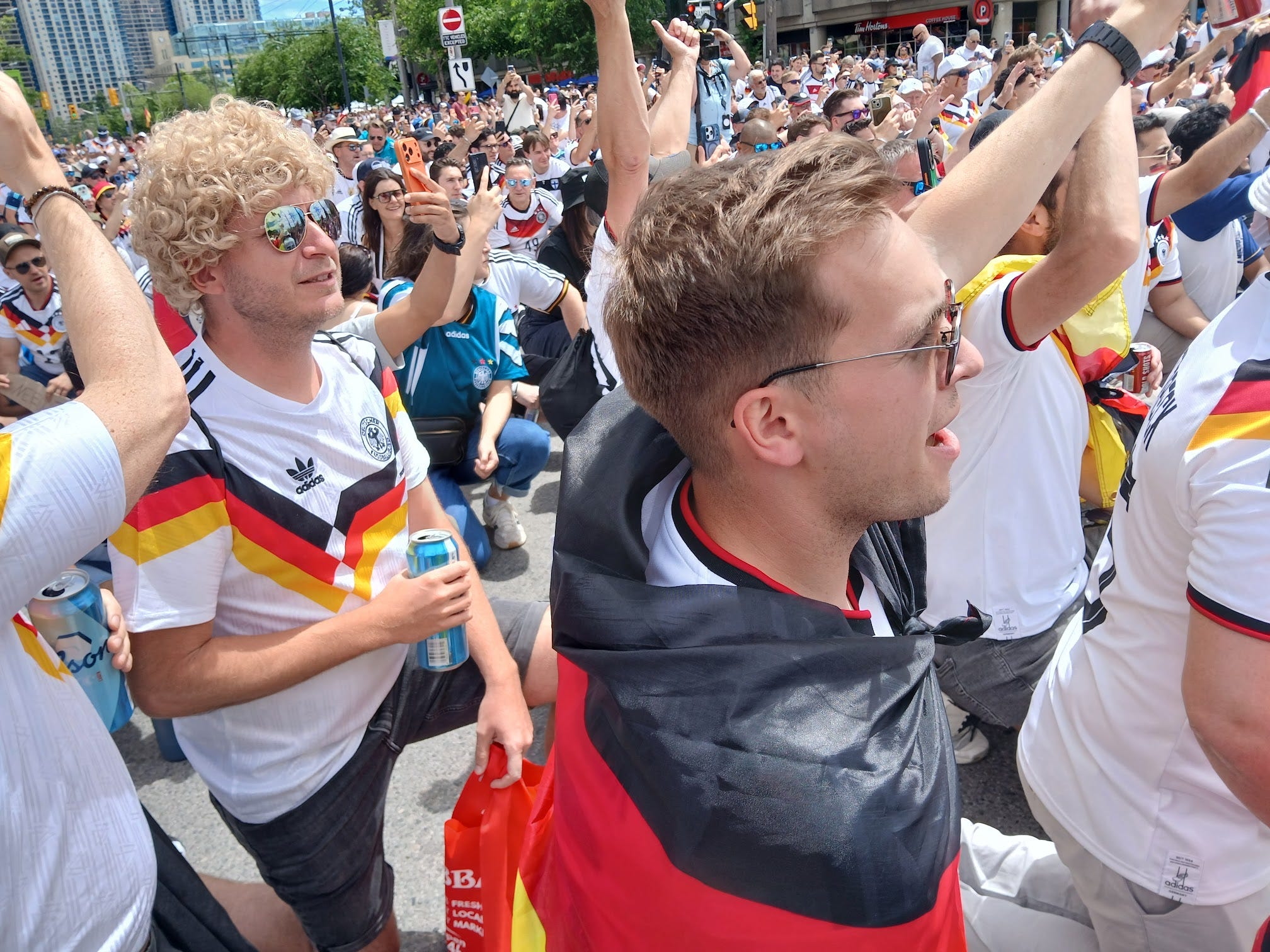
“Those who don’t live now will experience nothing / For those who don’t get anything done now, something’s wrong / The score has been decided, the sides are assigned / You feel you dream, you feel you believe, you fly / You fly“.
-30-